Just for the record, it’sa not me. Even before a haircut I am considerably bolder. 😇
Is AI the death of professional writers? I don’t think so. Writers can use AI to support their writing, rather than generate text. Human creativity is the only way to produce anything of any quality.
I am a novelist, and I also try to get the odd gig as a ghostwriter. (Being a novelist doesn’t pay that well.) I use AI to support my writing, not to create the sentences I write.
I have always embraced technology, and I have been an early adopter of many habits we now take for granted. I bought my first thing online before ‘online’ was a word, in the late 80s. It was a time of dial-up modems, CompuServe, and other bulletin boards. I bought Levi’s denim shorts for my six-month-old niece. Nobody in Italy had seen shorts with buttons that let you change the baby’s nappy (or diaper for US-based readers) without removing the shorts. Her mother loved it. I understand my niece used them for her daughters as well.
If you decide to support my work, you can ‘buy me a coffee’ a one-off tip by clicking on this link.
Many people are shocked when they hear I use AI. They are shocked because they do not know how I use it. If they are polite, or British, they try to mask their disappointment with a nervous smile. They assume I use AI to write; they add two and two and get six hundred and forty-five. I use AI to support my writing. Here is how a writer can use AI productively and ethically:
Research: It is faster: you ask a question and get a summary of the results along with the sources. It tells you immediately if you have asked the right question. If you did, then you can check the sources. A simple Google search gives you the sources, but you need to invest the time to read them to understand whether you asked the right question. If the summary is not enough, you can use your sources for a more in-depth analysis.
A first level of proofreading: AI-based tools like ProWritingAid or Grammarly helped me understand commas have a purpose; they are not just spread across the paragraph according to where they look better. Those tools also pick up typos in a way that a spellchecker could not, because the typo has changed the word (for instance, fake instead of take. In a Qwerty keyboard, the ‘f’ key is close to the ‘t’. It is a mistake, but the spellchecker will not pick it up because ‘fake’ exists and I spelt it correctly.) Take their verdicts as suggestions; you are the one with a brain, you decide. Some examples where I override what they tell me are (a) emphasis, sometimes you repeat a word to strengthen their meaning, it is not a mistake. (b) known inaccuracies: An AI tool is trained to point out repetition or unnecessary words; however, when you write in the past there is a difference between ‘I decided to do’, and ‘I did’. In the first case, you haven’t done it yet. Last but not least, (c) ProWritingAid hates adverbs and clutter words. However, because you are the one who thinks, you can decide whether to keep ‘very happy’, instead of ‘happy’ or ‘alarmingly prompt’ and replace it with ‘prompt’. ProWritingAid suggests. You decide.
A first, rough, draft of a translation:I am fluent in four languages and speak four more at various levels of proficiency. However, I am used to having only one language in my head at a time. I can switch quickly, but it is one language at a time. Translating means you need to keep two languages in your brain, and I find it exhausting. AI-based translation can be good, but it can also make the most extraordinary (and somehow silly) mistakes. Especially when a word is used in an idiomatic meaning. However, AI translation gives me a text in the other language that I will revise, and I still keep one language at a time in my head.
The next two points belong in the ‘if needs must’ category. In other words, technically, you should hire somebody, like a graphic designer or a photographer, but you may not have the budget for it. Therefore, AI is an acceptable substitute.
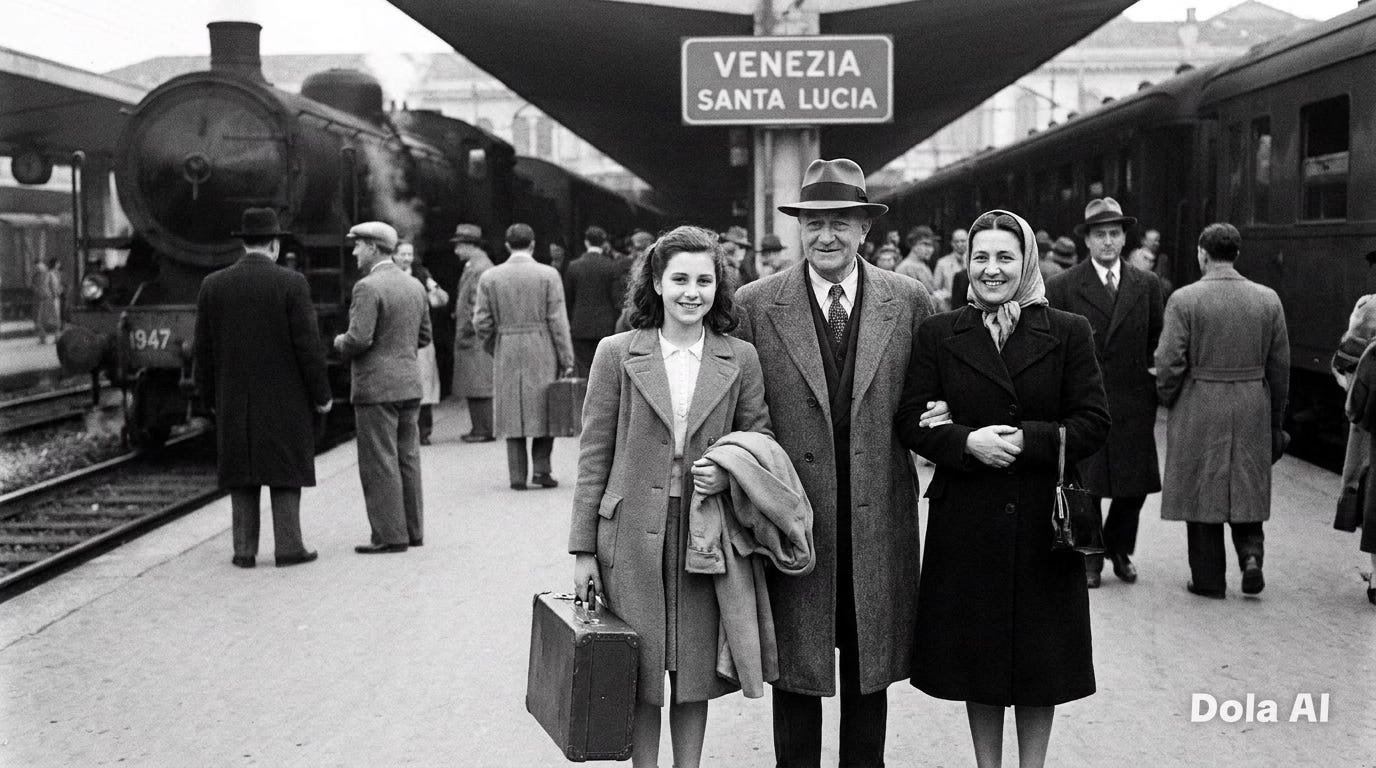
Image used in the Elena’s memory’s bool trailer, created using Dola AI
Create images:I use AI-generated images in some videos I create, and I credit the images to AI in the description. For instance, I needed an image of a couple and a teenage girl arriving at Venice station in 1947. The AI result is below. There is a caveat, try not to do that for places you do not know. The image above is the most realistic of all, I know how Venice Santa Lucia railway station looked in 1947. The AI platform I used created other images that had nothing to do with the way the station looked. Once again, AI suggests. You decide. Also, if you use an AI-generated image for the cover of your book, say so on the page where you would mention the credit for the photograph or the graphic. Your book would still count as ‘written by a human’.
Voiceovers: I have used AI-generated voiceovers out of frustration. I gave up when the umpteenth attempt at recording a Voiceover had to be stopped because of environmental noises. Usually, I record my own voiceover because if you write in English stories set in Venice, you have several Italian words. The English AI voice would butcher their pronunciation. If I have to write Rakeleh for the English AI voice to pronounce it close to the Italian pronunciation of Rachele, it is faster to use my voice, even after half a dozen attempts stymied by some noise. The videos where I used an AI-generated voiceover received divided feedback. Some preferred my voice, and others loved the AI-generated voice. Go figure.
Generative AI creates bland text. Also, it is seldom ‘generative’; it copies. AI can help create quality content; it cannot generate quality content without human intervention. It is a great tool, but I am not afraid it might replace me. There is more to creating content than putting words together. It takes a human to give words a voice.
New video (Not really)
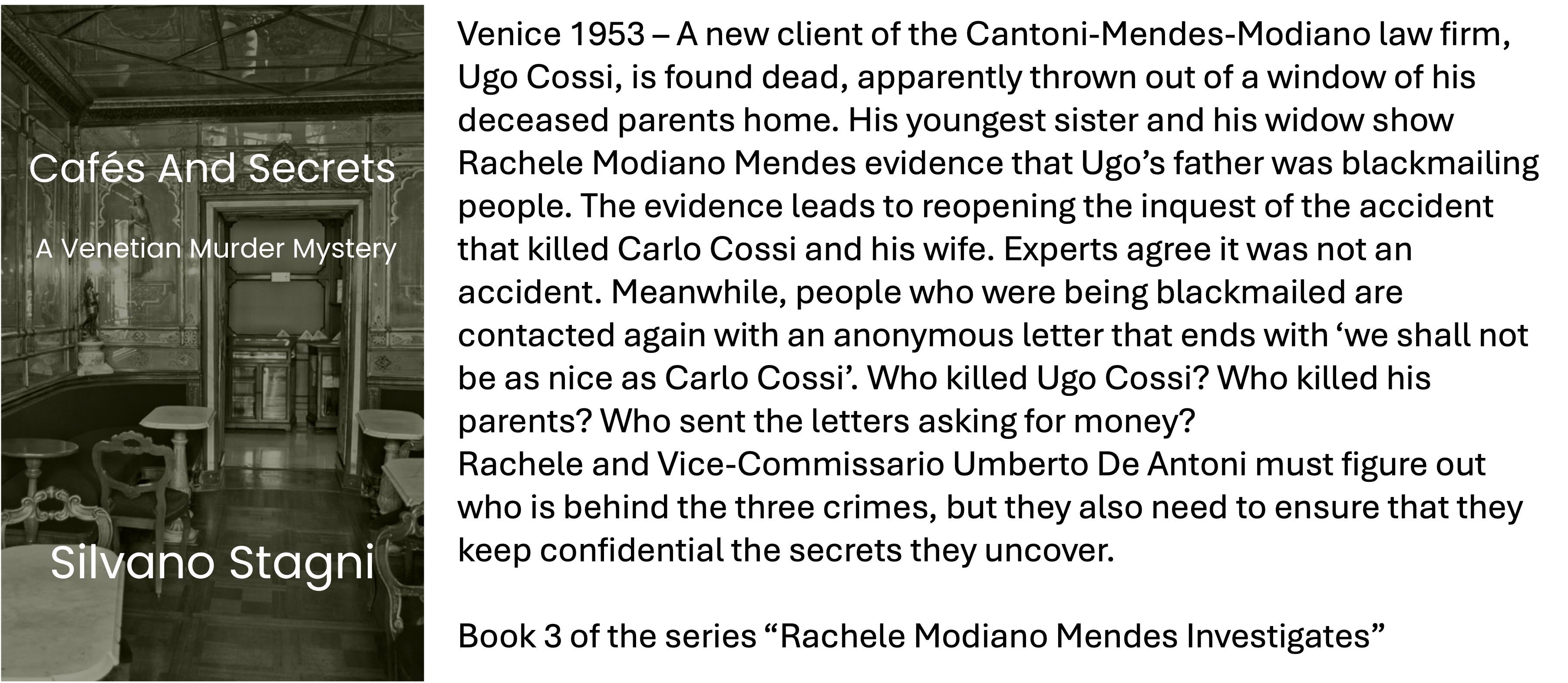
No new video this week, please take a look at the book trailer for my last book “Cafés and Secrets – A Venetian Mystery”
New videos are published most Wednesday. Here is the link to the channel, please like, comment and subscribe it helps with the algorithm.
Self-Publishing mini guides.
I am working at a number of mini-guides covering specific aspects of self-publishing.
The first one is a free pdf that details some of the basic aspects of self-publishing.
The third is not free, it is a 20 pages guide sharing what I learnt in the past three years. It allows you to turn a manuscript into a book on a shoestring budget. It costs USD 4 to download
It is also available as an ebook from Amazon at a slightly higher price (USD 5)
Where to find my books
I don’t just publish on Amazon. My book are available directly from me (i.e. Perpetuum Mobile Publishing) if you live in the UK or the US, or via a number of other places if you are elsewhere. Go to this page to find all the links (including Amazon).
Also, if you always wanted to write a memoir, but don’t think you know how, check my promotional offer here.
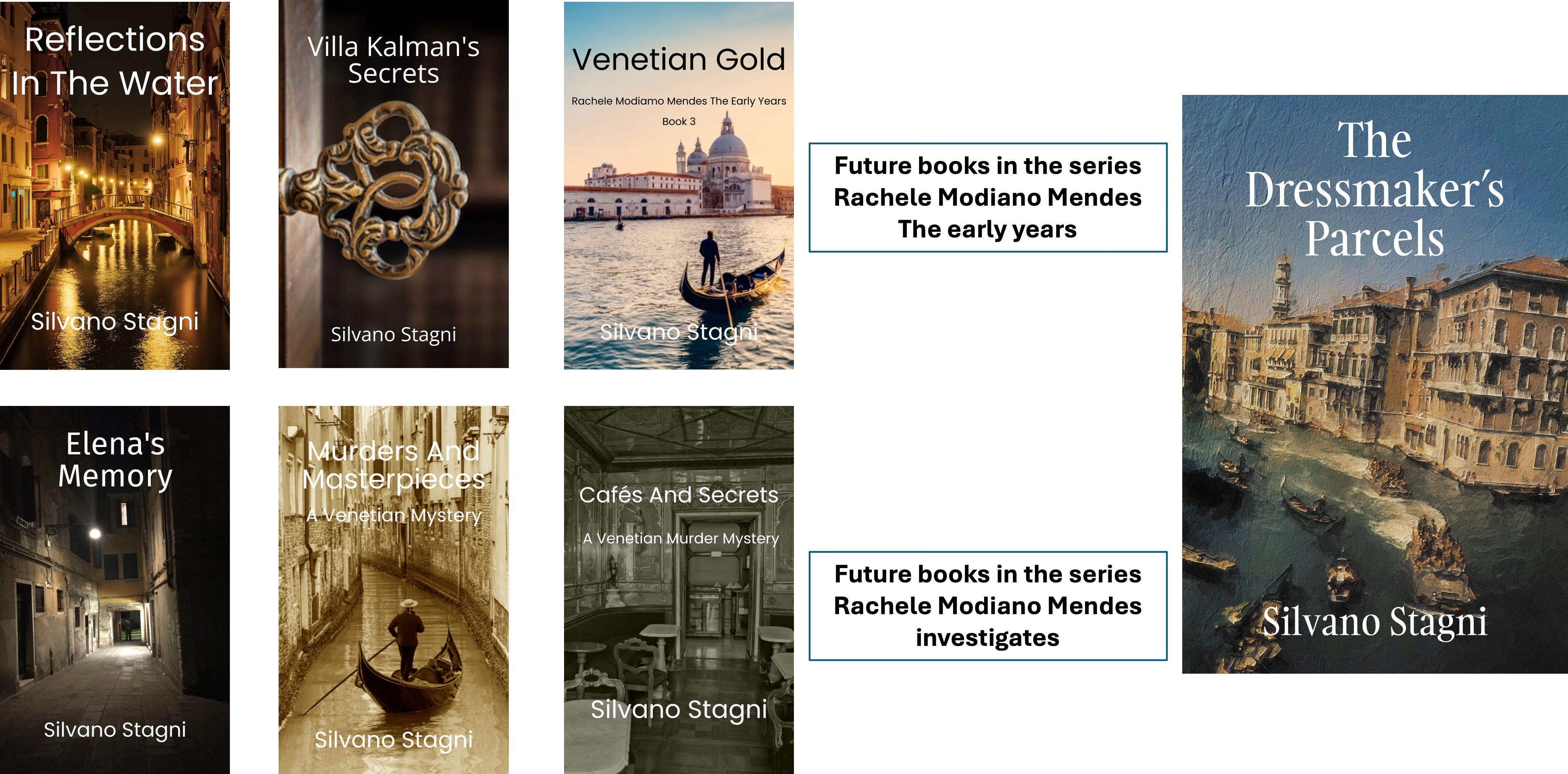
I have decided to keep my Substack free. However, if you decide to support my work, you can ‘buy me a coffee’ a one-off tip by clicking on this link, or you could buy one of my books (the link is in the caption of the last image below) or keep reading my posts, it is entirely up to you.
Cafes and Secrets – A Venetian Mystery is out. If you are based in the UK or in the US you can use this link to buy a paperback. You can only buy the eBook from Amazon. Other retailer are available here
I just don't agree, Sylvano. i don't want to ride the bucking bronco. What I write and what I think is all me - I don't want an interface. I like thinking; I like conjecture; I like making things up. I guess I'm a serious Luddite, out of step and soon will be left behind in this new world of unearned instant knowledge. Just leave me be to find my own way.




I just don't agree, Sylvano. i don't want to ride the bucking bronco. What I write and what I think is all me - I don't want an interface. I like thinking; I like conjecture; I like making things up. I guess I'm a serious Luddite, out of step and soon will be left behind in this new world of unearned instant knowledge. Just leave me be to find my own way.